
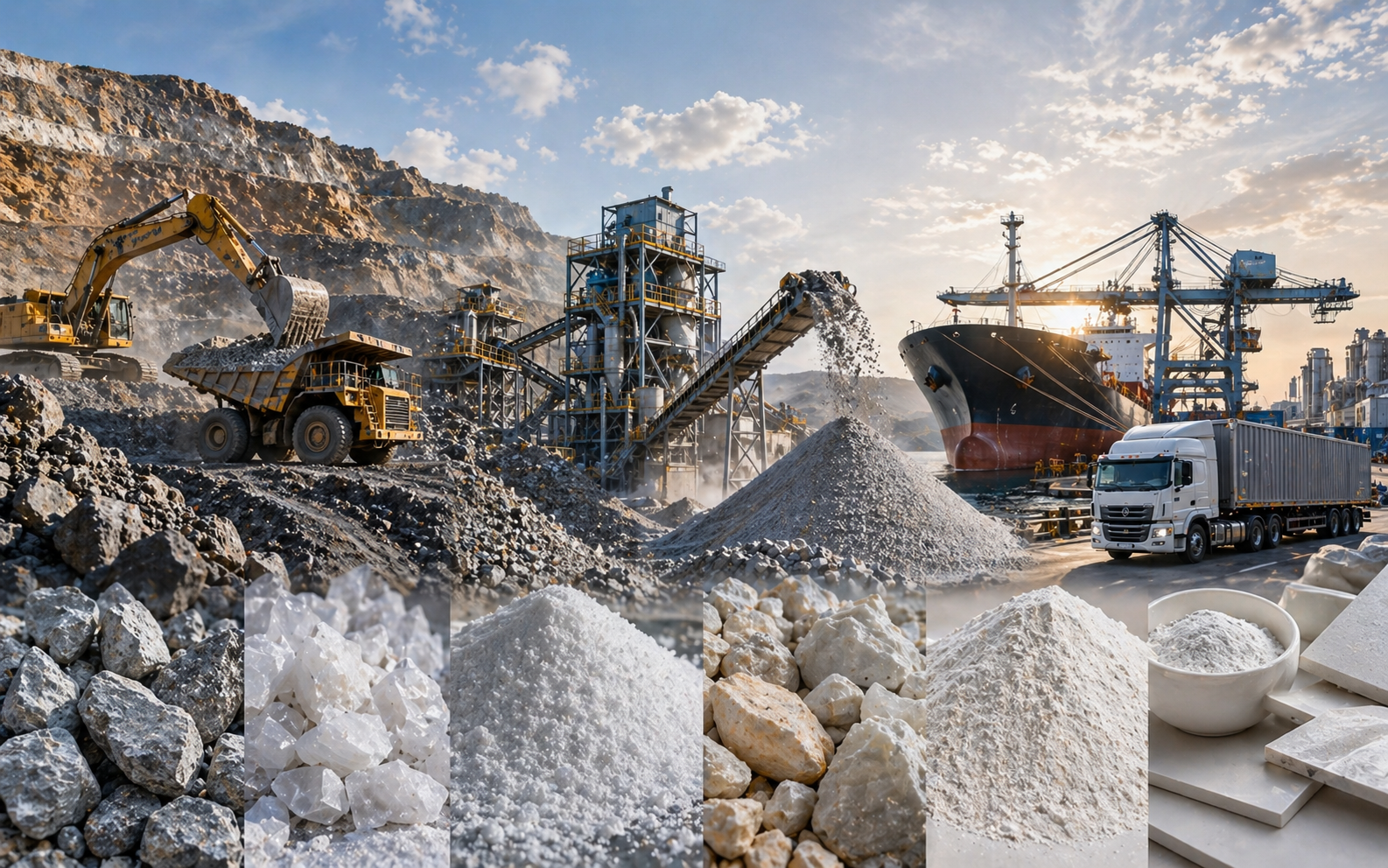
There are many variations of production and supply processes that help deliver refined mineral products suitable for multiple industrial requirements. Behind every fine mineral powder lies a detailed journey—one that begins deep within the earth and ends with precision-engineered materials ready to power industries worldwide.
Understanding the Origin: Mining the Raw Resources
The journey of minerals starts at the source—natural deposits formed over millions of years. These deposits are carefully identified through geological surveys and research to ensure quality and sustainability. Mining is the first step, where raw minerals such as limestone, dolomite, and clay are extracted using controlled techniques.
Modern mining practices focus not only on efficiency but also on environmental responsibility. Proper planning, minimal waste generation, and land restoration are essential aspects of responsible mineral extraction. The goal is to obtain high-quality raw materials while preserving ecological balance.
Primary Processing: Sorting and Preparation
Once extracted, the raw minerals undergo initial processing. At this stage, large rocks are broken down into smaller, manageable sizes using crushers. This process ensures uniformity and prepares the material for further refinement.
Sorting and screening follow, where impurities and unwanted particles are removed. This step is crucial because the purity of the mineral directly impacts its industrial performance. By eliminating contaminants early, manufacturers ensure consistency in the final product.
Grinding and Refinement: Achieving Precision
After primary processing, minerals move to the grinding phase. Here, advanced machinery is used to convert coarse material into fine powders such as calcite powder, dolomite powder, or talc powder.
Grinding is not just about reducing size—it’s about achieving the desired particle distribution, smoothness, and chemical consistency. Different industries require different specifications, and this stage allows manufacturers to customize mineral properties accordingly.
For instance, finer particles are often used in paints and coatings, while slightly coarser grades may be suitable for construction or ceramics. Precision in this stage defines the versatility of the mineral product.
Quality Control: Ensuring Excellence at Every Step
Quality is the backbone of any reliable mineral supply chain. Throughout the production process, strict quality checks are implemented to maintain consistency and performance.
Laboratory testing plays a key role in analyzing parameters such as particle size, brightness, chemical composition, and moisture content. Only materials that meet predefined standards move forward in the supply chain.
This commitment to quality ensures that industries receive minerals that perform reliably in their specific applications, whether in plastics, paints, paper, or construction.
Packaging and Storage: Preserving Integrity
Once the minerals are processed and tested, they are carefully packed to maintain their quality during transportation. Packaging solutions are designed to protect the material from moisture, contamination, and physical damage.
Efficient storage systems also play a role in preserving product integrity. Organized warehousing ensures that minerals are stored under optimal conditions, ready for timely dispatch.
Proper packaging and storage are essential because even the finest product can lose its value if not handled correctly before reaching the customer.
Logistics and Distribution: Reaching Global Markets
The final stage of the journey is distribution. A strong logistics network ensures that mineral products reach customers safely and on time. This involves coordination across transportation modes, supply chain management, and timely delivery schedules.
Export-oriented companies focus on meeting international standards and ensuring smooth documentation and compliance. Reliable distribution builds trust and strengthens long-term relationships with clients across industries.
Efficiency in logistics is not just about speed—it’s about consistency, reliability, and the ability to meet diverse customer demands.
The Role of Expertise and Experience
A seamless journey from source to supply requires deep industry knowledge and operational expertise. Companies with years of experience understand the importance of maintaining quality, optimizing processes, and adapting to changing market needs.
From selecting the right raw materials to delivering finished products, every step requires precision and commitment. This is where established manufacturers make a difference by combining traditional knowledge with modern technology.
Driving Industrial Growth Through Minerals
Minerals are fundamental to countless industries. From construction and infrastructure to paints, plastics, and ceramics, refined mineral products support innovation and growth.
The journey from raw extraction to refined supply is not just a process—it’s a value chain that transforms natural resources into essential industrial solutions. Each stage adds value, ensuring that the final product meets the highest standards of performance and reliability.
Conclusion
The journey of minerals from source to supply is a well-orchestrated process involving extraction, refinement, quality control, and distribution. It reflects a commitment to precision, sustainability, and excellence.
By understanding this journey, one can truly appreciate the effort and expertise involved in delivering high-quality mineral products. It is this dedication that enables industries to rely on minerals as a foundation for innovation and progress.