
Premium Hydrous Clay Solutions
Hydrous clay is a finely processed natural mineral known for its excellent brightness, softness, and smooth texture. At Shiv Rudra Minerals International, we manufacture high-quality hydrous clay with consistent particle size and purity, making it suitable for diverse industrial applications. Our advanced processing ensures superior dispersion, enhanced performance, and reliable quality, meeting the evolving needs of industries like ceramics, paints, rubber, and paper.
With a commitment to excellence since 2005, we deliver hydrous clay that enhances product performance while maintaining cost efficiency and long-term reliability.
- Properties
- Application
- Chemical Composition
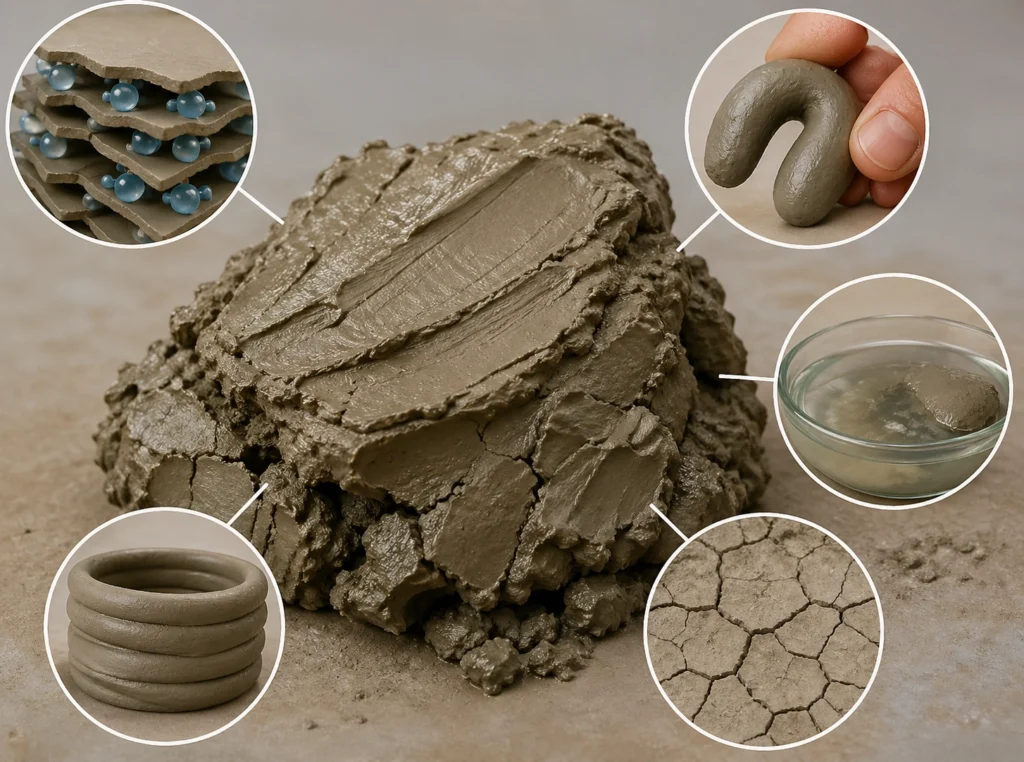
Hydrous clay, commonly referred to as hydrated clay, possesses several characteristics that make it valuable across a wide range of industrial applications. One of its key properties is its excellent water absorption capacity, making it highly effective as a drying agent. Its natural plasticity allows it to be easily molded and shaped, making it widely suitable for pottery and ceramic applications. In addition, hydrous clay exhibits low shrinkage, making it an ideal filler material in the construction sector. It also offers strong adhesive qualities, enabling its use as a bonding agent in the production of refractory bricks and other heat-resistant materials. Furthermore, hydrous clay demonstrates excellent chemical stability, providing resistance against chemical reactions and making it suitable as a protective coating material for pipes and industrial equipment.
Hydrous clay, commonly referred to as hydrated clay, is widely utilized across multiple industries due to its versatile physical and chemical properties. Key applications of hydrous clay include:
- Cosmetics: Used extensively in skincare and cosmetic products for its excellent oil and impurity absorption properties, making it ideal for facial masks, cleansers, and exfoliating scrubs.
- Paper Industry: Owing to its high surface area and fine particle size, hydrous clay serves as an effective filler in paper manufacturing, enhancing smoothness, strength, brightness, and print quality.
- Ceramics: Hydrous clay is widely used in ceramic applications because of its superior plasticity, allowing easy shaping, molding, and finishing of ceramic products.
- Paints and Coatings: Incorporated in paints and coatings to improve rheological characteristics such as viscosity and stability, while also enhancing crack resistance and overall durability.
- Oil & Gas Drilling: Used as an important component in drilling mud formulations to control viscosity and density, reduce fluid loss, and provide lubrication during drilling operations.
Hydrous clay, commonly known as kaolin, is a naturally occurring clay mineral with the chemical formula Al₂Si₂O₅(OH)₄. It consists of layered silicate tetrahedrons and octahedrons, with water molecules present between the layers. The composition of hydrous clay varies depending on its source, but it generally contains around 46–65% silica, 14–35% alumina, and 0–15% iron oxide. It may also include trace minerals such as feldspar, mica, and quartz.
Frequently Asked Questions
Yes, it meets strict quality standards and is ideal for multiple industrial applications.